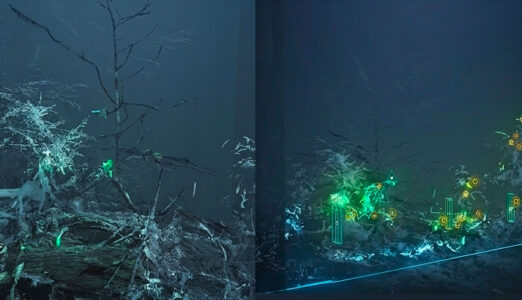
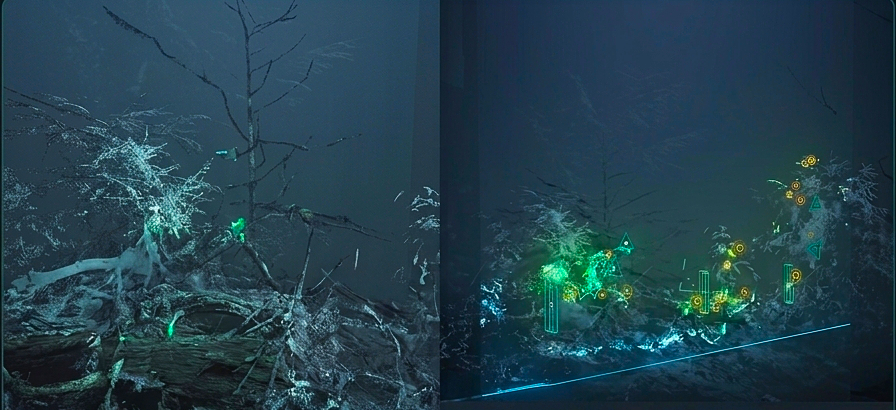
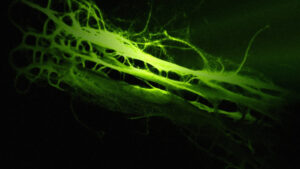
There is a forest in a remote mountain location in the Italian Dolomites, where some spruce trees have been wired up by researchers to measure their electrical biorhythms. The scientists that have been working with these trees swear that the data shows that the trees and the forest predicted and responded bio-electrically during a solar eclipse. This finding is being actively argued over in the science community right now.
This suggesting that the forest collectively registered the sudden environmental transformations produced by the celestial event. The scientifically debated findings raise provocative questions about the sensitivity of vegetal sensing systems and the possibility of distributed forest-scale signalling – and even foretelling.
Forests in Europe and beyond are increasingly being monitored and sensed. Wired up, connected, the forest wears a new sensory platform to forecast- and to perform the act of prophesier. Actions such as fire-watch, of impacts of human-induced climate change, of celestial activity.
Theoretician, Jennifer Gabrys, talks about “the forest that computes” and also speculates on ‘Program Earth’- a speculative programmable earth where humans attempt to model and intervene into planetary processes with increasing precision. Other thinkers include Lisa Parks and her ideas of politics of satellite vision and remote sensing, and Nigel Clark and thoughts on deep-time ecological dynamics.
Forests, atmospheres, soils become computational surfaces; but also ecological actors.
Thinkg around emerging understandings of plant intelligence; of vegetal ways of knowing and worlding.
Speculating on current and experimental science and technology around remote sensing for human land management intentions.
If forests are increasingly sensed through technological infrastructures, how might humans meaning fully perceive these signals beyond conventional scientific graphs; to attune to the forest?
Thinking around the lineage of “calm technology” and “ambient computing” and interfaces allowing information to be
perceived in multimodal and peripheral ways over time, tapping into humans innate capacity for embodied attunement and pattern recognition.
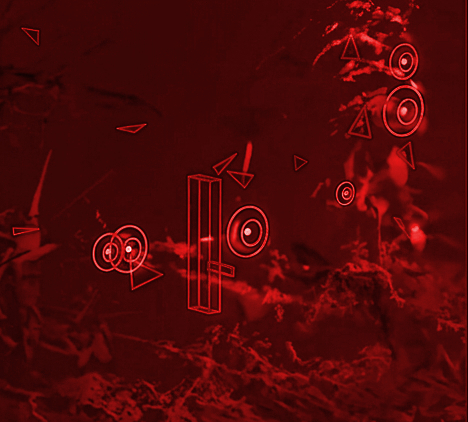
The research project imagines systems where humans are seen as participants within an extended human- plant sensorium, sensing environmental changes through shared “perceptual fields” accessed through
para-visual modalities.
How might we encounter forest bodies and theircomputational reflections through our own bodies?
reference:
Plant intelligence and signalling as speculated in my recent art-science work:
Dr Monica Gagliano:
https://refractor.io/biology/trees-knowledge-eclipse/
and-
Bioelectrical synchronisation of Spruce trees in Dolomite forest
“virtual tree’: https://www.hiilipuu.fi/